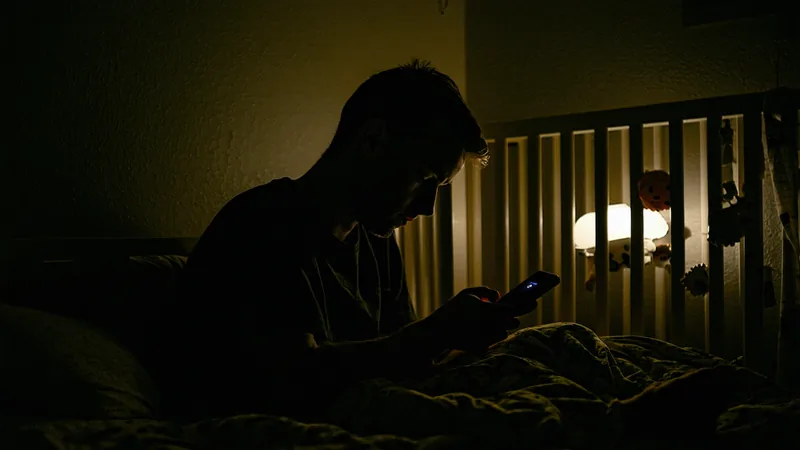
My daughter was born in late 2023. I say that because I want you to understand the timeline: I was not fresh off reading about some market opportunity. I was in the middle of it. I was awake at 3am logging formula volumes into my phone's notes app because the paper notebook by the crib had become unreadable three days in.
My partner was on one shift, I was on the other. We had a system — sort of. She'd take midnight to 4am, I'd take 4am to whenever the day started. The "system" required that we communicate handoffs. Feed times. Volumes. Which side last if she was nursing. Diaper count. Sleep start time.
We communicated all of this through an iMessage thread that had 240 messages in it by day six.
The iMessage thread was actually the app I wanted
This is a strange thing to realize, but I think it's important: the behavior we were already doing — texting each other feed updates — was basically the right behavior. We needed a shared timestamped log of infant care events, attributed to whoever did them. That's exactly what we were building in iMessage, badly.
The problems with the iMessage version were obvious. No structure. No search. No cumulative view. When the pediatrician asked at the 2-month appointment how much she'd been taking in the last 48 hours, I scrolled back through 80 messages trying to do math. The appointment took longer because I was unprepared. I felt like a fool for not having a better system.
"I didn't need a baby app. I needed our iMessage thread to be a database."
I'm a software engineer. I've been building web and mobile software for about twelve years. When I realized what I actually wanted, I spent a weekend building v1 of what became Xoul. Not because I thought it would be a company — I thought I was solving my own problem. A shared log with timestamps, volume fields, caregiver attribution, and a simple timeline view.
My partner used it that night. By the end of the week, the iMessage thread was quiet.
Why the existing apps didn't work
I did look, before building. I spent a few nights trying apps from the App Store. Huckleberry was beautiful and well-funded, with a good sleep tracking experience — but multi-caregiver was secondary, and the premium sleep coaching features pushed it into territory we didn't want (more on that below). Baby Connect had the right multi-caregiver idea — it's genuinely been doing shared logs for years — but the UX was built for a different era and felt designed for one person filling out a paper form. Glow Baby was fertility-first and had adapted to baby tracking, but its multi-caregiver was clearly bolted on.
The apps were either single-caregiver tools that bolted multi-user on as a feature, or they were approaching "medical dashboard" territory with sleep coaching, developmental predictions, and AI-labeling of sleep patterns. Neither was what we needed. We needed something honest about what it was: a shared household log.
The sleep coaching feature we decided not to build
One of the earlier design debates was whether to add a sleep coaching component — something that would tell parents to try letting the baby sleep through or recommend specific sleep training approaches. We decided not to, and I want to explain why, because I think it's a values statement more than a product decision.
Sleep training is an intensely personal choice. Cry-it-out, Ferber, no-cry methods — these are decisions that involve parental values, pediatric guidance, the baby's specific temperament, and circumstances we can't see. I am not qualified to make that recommendation. An algorithm looking at sleep log data is not qualified to make that recommendation. The moment an app starts telling you to let your baby cry, it has crossed from tool into advisor, and it's carrying a liability it can't justify.
Xoul shows you when sleep is likely available based on your baby's own logged patterns. What you do with that information is yours. We are not a sleep coach. We are not a medical device. We are a personal organizer for your household, and we're honest about that.
What happened next — finding a co-founder
In early 2024, I showed the v1 prototype to Maya Chen, a colleague who had been thinking about the same problem from a product angle. She had a 2-year-old and had been through the same multi-caregiver coordination problem eighteen months earlier. Her observation was that the prototype solved the logging problem but hadn't thought hard enough about the hand-off summary — the view that tells an incoming caregiver what happened in the last four hours without reading the full log.
She was right. That became the second major feature. Maya joined as CTO and co-founder. We incorporated in early 2024, built through the spring, and launched Xoul v1.0 in March 2025.
We are bootstrapped. We didn't raise outside capital, and we're not planning to. At $5.99/month, we need a few hundred paying households to sustain two engineers in Austin. That feels like an honest bar. We didn't want to build a data monetization engine to fund the company — we wanted to build a household tool and charge a fair price for it.
We're still a two-person team. The app is built by two people who have been in the house at 3am, who know what information you need and when, and who made a conscious choice not to overpromise what software can do for a tired parent.
What we chose not to build
There were features on the early list that we cut. Sleep coaching — the kind where the app tells you to let your baby cry through a window — was on the list and got removed. Not because we have strong opinions about Ferber versus no-cry sleep versus any other method. We cut it because we're not pediatric sleep specialists, and we don't think an app should be prescribing behavior in that territory. The app shows you estimated wake windows and sleep availability. Everything else is yours.
Developmental milestone tracking was also on the list. We cut it because it's not what we were actually trying to solve. There are apps that do milestones reasonably well. We were trying to solve the "what happened at 2am and who knows about it" problem. Adding milestones would have diluted that focus without making the core product better.
The pediatric flag system almost didn't make the cut either. The risk of getting health-adjacent features wrong felt high enough that we considered leaving them out entirely. We kept them because the absence of a thoughtful, low-noise flag system is also a failure mode — parents miss things they would have noticed with a better-structured log. We spent significant time on getting the thresholds calibrated toward "things worth calling your pediatrician about" rather than "things that happen every day."
None of this is marketing positioning. It's the actual set of choices we made while building a product that we, personally, needed to be honest about. If Xoul had a feature that overpromised, we'd be the first ones trusting it with our own kids.
If you're in the thick of it right now — awake with a partner, trying to coordinate the overnight — the app is free to start. Download it tonight, add your partner, and see if it solves the problem we built it to solve. If it doesn't, email us: [email protected]. We read every one.